1913 - Portland Crucible
The suffrage victory in November 1912 was the opening move. But the real prize — control of Oregon’s political infrastructure — was won in the summer of 1913, during a crisis that, in the original timeline, simply broke people.
Res Ops knew it was coming. Future scouting in late 1912 had mapped the contours: unemployment spike in spring, a women’s cannery strike in summer, a Free Speech Fight that would fill the jails and radicalize a generation of Portland activists. They’d seen the outcomes. They knew which police officers would beat which speakers, which judges would hand down the harshest sentences, which newspapers would inflame and which would sympathize.
The Commission Government (May 1913)
Portland adopted a commission form of government in May 1913, replacing the old mayor-council system. The charter passed by 292 votes out of more than 34,000 cast. In the original timeline, that margin was terrifyingly thin — a few hundred people in different precincts and the entire reform collapses.
The suffrage network built in 1912 — the transportation committees, the women’s clubs, the union halls — was repurposed. Progressive-leaning voters in East Portland neighborhoods received personal visits from “civic engagement volunteers.” A few newspaper endorsements were placed strategically. The margin held, and was increased to 542 votes.
H. Russell Albee became mayor, as before. He was a Progressive Republican, sympathetic to craft unionism, backed by the Roosevelt Progressive wing. He was exactly the man Res Ops wanted in the chair — not because he was their puppet, but because he was genuinely reform-minded and could be guided without knowing he was being guided. The key was feeding him information through channels he trusted: newspaper editors, civic leaders, the business owners who owed Cooperative Research favors.
The Unemployment Crisis (Spring 1913)
The economic downturn that hit Portland in 1913 was not unique to the Commonwealth timeline — it was a function of national credit tightening, the end of a railroad construction boom, and seasonal layoffs in the timber industry. It would have happened regardless of Res Ops’s interventions.
What Res Ops changed was the response.
In the original timeline, approximately 400 unemployed workers stormed Portland City Hall, demanding shelter and food. The city reacted with a mix of reluctant accommodation and repression. Temporary shelters were opened, but they were inadequate, and the crisis faded only when the economy recovered on its own. The political lesson absorbed by Portland’s establishment was: unemployed people are dangerous; manage them.
In this timeline, Res Ops knew the storming of City Hall was coming. They also knew that, in the original timeline, it achieved nothing lasting. So they did something more sophisticated: they organized the unemployed before the demonstration happened.
Through IWW contacts and the labor network established during the suffrage campaign, they identified natural leaders among the unemployed — men who had been foremen, shop stewards, or petty bureaucrats before they lost their jobs. These men were quietly brought together, given a structure, and pointed at a set of specific, achievable demands:
- A municipal employment bureau, staffed by the city, to match workers with available jobs
- Public works projects — road repair, park maintenance, sewer construction — funded by city bonds
- A shelter system run through existing churches and union halls, with city reimbursement for costs
- A moratorium on evictions during the crisis
When the 400 workers arrived at City Hall, they didn’t just storm in and shout. They had a printed list of demands, a designated spokesman, and a plan for what to do if the city said yes and what to do if it said no. They looked less like a mob and more like a delegation.
Albee, who was already being fed information suggesting that a constructive response would be politically advantageous, agreed to most of the demands. The municipal employment bureau was established within the month. The public works projects were slower — bond issues take time — but they were announced, which mattered more than immediate implementation.
The political lesson absorbed by Portland’s establishment in this timeline was different: unemployed people, when organized, can extract concessions. You should probably give them jobs before they get organized.
This was the foundation of what would become Oregon’s unemployment insurance system.
The Oregon Packing Company Strike (June-July 1913)
The strike at the Oregon Packing Company cannery on Southeast Seventh and Belmont was the spark. Fifty women walked out on June 27, 1913, protesting twelve-hour workdays, piece-rate wages under a dollar a day, and conditions that included chaining the doors shut to keep union organizers out.
Res Ops knew about this strike before it happened. They also knew what it would become: a Free Speech Fight that would fill Portland’s jails, radicalize Marie Equi, and establish the IWW as a force in Pacific Northwest labor politics.
The question was: what did they want to happen?
This is one of the few places we do have some information from within Res Ops. Res Ops has some of the best internal security that has ever existed in an organization, mostly because they are completely full of true believers to the cause, and almost no one is willing to talk about their experiences there, to the point that we do not even know the name of the head of Res Ops between 1908 and 1941, when it was transferred from Cooperative Research into the Strategic Forecasting Directorate, part of the Commonwealth of All People. We know it was a woman, possibly a ‘young woman’, and that her husband also worked there, and that is basically the end of what we know.
However, there are places where information has leaked, and this is one of them. The dispute was apparently over ‘Do we just protect the women, or do we use this?’.
It’s likely something that Res Ops and the founders had faced before with the LA Times Bombing: Do we let tragedy happen, or do we stop it?
The LA Times bombing they let happen exactly as it always had, and it killed 21 people. We don’t really know if there was an internal dispute over that. Or, perhaps, they did run an experiment in stopping it, and the results were worse…if that particular bombing had not started a fire and killed people, the bombings would have continued, and perhaps what would have happened would have been worse.
Here, though, we do know there was some sort of internal discussion among the leader of Res-Ops, and Flynn and Equi, and hints even of a dispute between Flynn and Equi. Despite the fact no one actually died there, just a lot of women were beaten. We don’t even know what the sides were.
We can even be cynical and point out that Equi was very actively involved in the Oregon Packing Company Strike the first time around, and knew the women, in fact the sight of police beating them became so radicalizing that she fought for labor her entire life.
So perhaps it might just be allowing harm to come to people you know is different than allowing the deaths of strangers. Or, alternately, maybe Equi was on the other side and wanted her younger self radicalized. Who can know?
Regardless, it looks like Res Ops deliberately threaded the needle.
Mayor Albee’s major weakness throughout this was his desire to be “impartial.” In other timelines, this led him to authorize Sheriff Tom Word to take a hard line against the IWW speakers during the Free Speech Fight, even though Albee personally sympathized with the strikers. He tried to split the difference and ended up legitimizing police violence.
Res Ops’s adjustment was subtle: they made sure Albee received detailed, credible information about Sheriff Word instances of excessive force, complaints from civic groups, pressure from church leaders, before all this. They didn’t tell him what to do. They made sure that when the moment came, the weight of information tipped him toward restraint rather than crackdown.
It didn’t fully work. Albee still authorized arrests. But the level of violence was lower than in the original timeline. Fewer broken bones. No trampling by mounted police. The jails still filled, but the emergency room didn’t.
Equi’s Arrest
Marie Equi, age 41, was not a labor activist in June 1913. She was a feminist activist, almost entirely. She cared about women’s health, about abortion, about domestic violence, about women’s right to vote which would help them demand other changes.
And ultimately, she was just a physician who treated women.
Like the women working at Oregon Packing. When her patients came in with burns from the chained-door heat, with hands raw from twelve hours of piece-rate cannery work, she was furious. When she saw police on horseback driving through crowds of striking women, she was incensed. As someone else in an entirely different timeline on the other side of the country would write, ‘Injustice Anywhere Is a Threat to Justice Everywhere’.
She didn’t join the labor movement because someone told her to. Or the fight for free speech and against the government trying to clmap down on it.
She joined because she was Dr. Marie Equi, and she realized everything was connected. If workers are abused by employers, female workers are abused by employers. If the police will assault protestors, they will assault female protestors.
On the day she was arrested, she stood on a soapbox at Southwest Third and Stark, read the First Amendment aloud, and waited for the police to drag her off. They did. She went to jail.
In other timelines she came out the next day and went back to the soapbox.
In this timeline she came out the next day and went on a newsreel. The 26 second clip of her talking calmly, dispassionately, about the violent behavior of the police against women who desperately needed money, but faced unhuman working conditions and could no longer stand them, played before movies for weeks, and was replayed repeated on the radio news. Along with the pre-existing newspaper coverage.
Res Ops apparently had a lawyer waiting. However, Equi, on the lookout for suspicious behavior of that sort, rejected him, and selected one of the many other lawyers clamoring to represent her. But it didn’t matter, the charges were dropped within a week, the public pressure made any prosecution explosive.
Equi was transformed. The woman who walked into that fight was a doctor with sympathies. The woman who walked out was a radical. This is what had always happened, it’s just this time she ended up a national figurehead, almost certainly without the intentions of Res Ops.
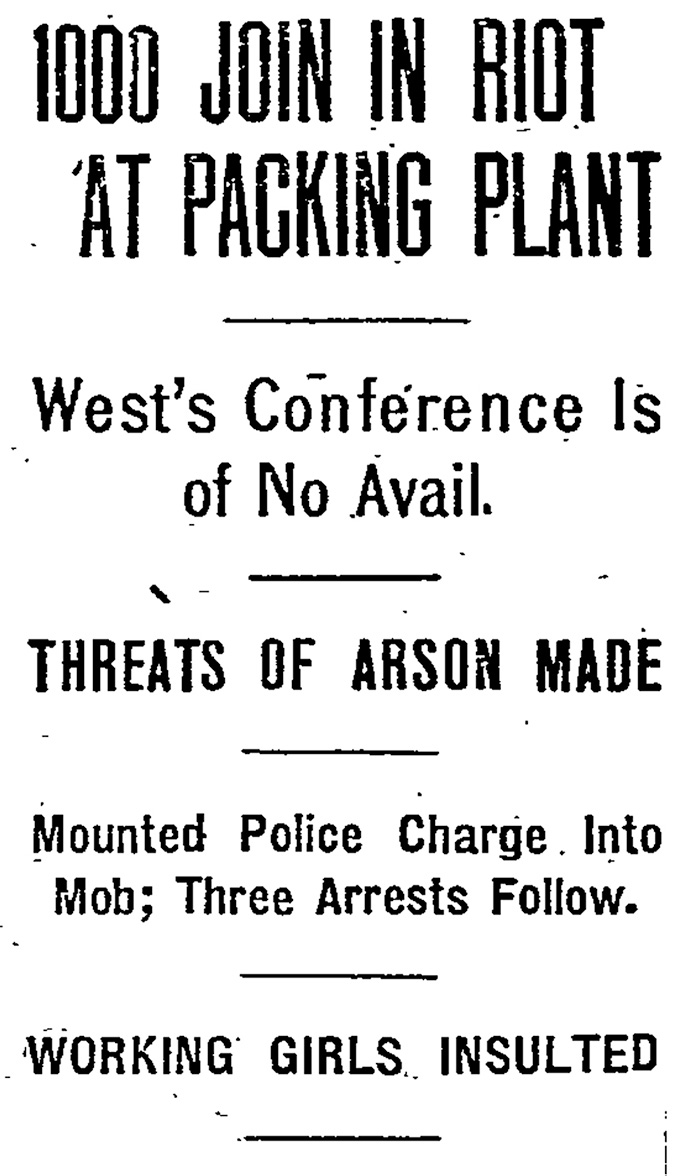
-July 13, 1913, The Oregonian